



Step in Lock Dog Harness Guide: Fit, Use and Safety
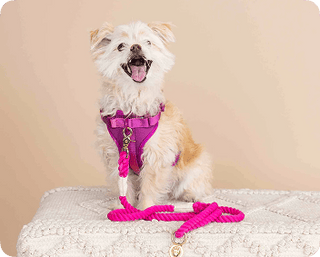
A step in lock dog harness is a back-clip harness your dog steps into rather than having anything pulled over their head. The dog places their front legs into two loops, the harness lifts up over the shoulders, and a buckle or locking closure fastens securely on the back. At Pink Papyrus Co., we find this style especially useful for pets that resist over-the-head gear.
What "step in," "lock," and "air" actually mean
The step-in part is about how the harness goes on. You lay it flat, your pet places their front paws into two triangle-shaped loops, then you lift the harness up over the shoulders and fasten the closure on the back. For a clear visual guide to this step-in process, see How to Properly Put on a Dog Harness. Nothing goes over the head, which matters a lot for dogs with ear or neck sensitivity, or for any pet that tenses up at the sight of something descending toward their face.
"Lock" in product names refers to closure security, not a different harness shape. It typically means the buckle includes a reinforced or locking clip that stays firmly in place rather than releasing under pressure. Think of it as an added confidence feature on the same step-in design.
"Air" is a material descriptor.
In step-in harness products, it refers to lightweight, breathable mesh fabric that allows airflow next to the skin.
If you see both terms in the same product name, the harness is a breathable mesh step-in design with a secure locking closure.
The two words describe construction and security, not different putting-on methods.

Step-in harnesses for cats: same motion, different animal
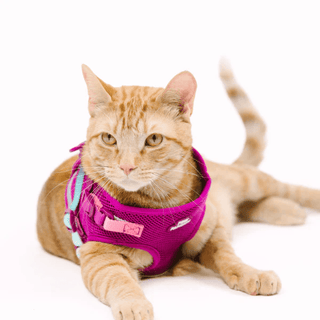
A step in lock cats harness works on the same putting-on principle, but cats are not simply small dogs. Their bodies are more flexible, their escape instinct is stronger, and they need a much slower introduction to wearing any kind of gear.
For cats, a well-fitted harness with a secure closure is essential because no cat harness is fully escape-proof. Breathable mesh with a back closure that avoids going over the head is a lower-stress option than many alternatives, and a snug, carefully adjusted fit is your best protection against a determined escape.
Our Atlas Cat Harness & Leash Set features four-way adjustability, lightweight breathable mesh, reflective detailing, and a hidden AirTag pocket. It comes in three sizes based on chest girth: Small for an 11 to 13.7 inch chest, Medium for 12.6 to 16.1 inches, and Large for 15 to 18.9 inches. Measure your cat's chest before ordering.
Step-in vs. other harness styles at a glance
| Feature | Step-In Harness | No-Pull Front-Clip Harness | Over-the-Head Harness |
|---|---|---|---|
| How it goes on | Pet steps front legs in, harness lifts up and clips on the back | Same or overhead, leash clips at the chest | Slips over the head, clips at the back or chest |
| Best for | Calm walkers, head-sensitive pets, small breeds, cats | Dogs that pull on leash, active dogs needing direction control | Dogs comfortable with overhead movement |
| Pulling control | Low, back clip gives less control over direction | High, chest clip turns the dog naturally when pulling | Moderate, depends on leash attachment point |
| Escape risk | Low to moderate with a secure closure; fit is critical | Low to moderate | Low with a snug fit |
If your dog pulls hard on walks, a step-in design alone will not solve it. A Review of Collars, Harnesses, and Head Collars for Walking Dogs notes that no single restraint works best for every dog, so the right choice depends on the dog and guardian’s needs. If you are deciding whether a harness or collar is better for your dog, consider your dog's pulling strength, neck sensitivity, and walking behavior.
Understanding the types of harnesses for dogs can help you choose a design that suits your dog's walking habits. A no-pull harness with a front-clip attachment gives far better direction control and is worth pairing with consistent leash training. Our Dog Harnesses collection includes both step-in and no-pull options, so you can match the harness to your dog's actual behavior rather than just the product name.
How to put a step-in harness on correctly
- Lay the harness flat on the floor with the two leg loops clearly visible and the back closure facing up. Check that straps are not twisted before your pet steps in.
- Guide your pet to stand over the harness, then lift their front paws one at a time into the two loops. For a fidgety dog, hold a treat at nose level to encourage them to stand still. For a cat, have a small amount of wet food nearby to keep the introduction calm.
- Lift the harness up along both sides of the body until it sits snugly around the shoulders and chest. The back panel should rest across the shoulders, not slide toward the belly.
- Fasten the closure on the back firmly. If the harness has a locking buckle, press until you hear or feel it click securely into place.
- Slide two fingers under the chest and girth straps to confirm there is room but no significant slack. The strap running behind the front legs should not press into the armpits.
- Walk your pet a few steps and confirm the front legs move freely without restriction. Then pull the harness gently in different directions to make sure your pet cannot back out of it.
Getting the fit right
For dogs, measure around the widest part of the rib cage and around the neck.
If your dog falls between sizes, go up.
Our Atlas Dog Harness comes in XS through L, with chest ranges from 13 to 38 inches, and each size includes a detailed size guide.
Our customer care team can also help if you are unsure which size to choose. For a broader guide, see how are dog harnesses supposed to fit before adjusting the harness for daily walks.
For small dogs and tiny breeds, fit is especially unforgiving. A harness that slips even a little can become an escape route or a rubbing point. The girth strap should sit around the rib cage, not behind it toward the stomach, and should not dig into the backs of the front legs during movement.
Cats need the same two-finger check. Their harness should be removed after outdoor sessions rather than worn all day, since prolonged wear can cause hair loss and skin irritation from rubbing, particularly around the armpits or anywhere a strap sits incorrectly. If you are wondering can a dog wear a harness all the time, it is generally best to remove it during rest and check regularly for rubbing or skin irritation.
Signs the fit is off
- The girth strap sits behind the rib cage toward the stomach rather than around the rib cage
- Straps dig into the backs of the front legs when the pet walks
- Your pet backs out or squirms free with little effort
- Red skin, thinning hair, or visible irritation anywhere a strap contacts the body
- Front legs look restricted or your pet moves stiffly or awkwardly
Introducing a harness to a cat, step by step
Cats need time. Rushing the process usually sets you back further than going slowly, and gradual positive introductions work far better than trying to get your cat outdoors on the first day.
- Let the cat sniff and investigate the harness while offering high-value treats or a small amount of wet food, so the harness becomes associated with something good before it ever touches them.
- Put the harness on while feeding, then remove it quickly. Repeat until the cat stays relaxed during this step.
- Leave the harness on for short periods indoors, continuing to pair it with treats or play. Watch for signs of discomfort: ears turned back, tail swishing, freezing in place, or repeated attempts to bite at the harness.
- Attach the leash and let the cat drag it around the house without you holding it. This removes the sensation of leash pressure while keeping the setup familiar.
- Pick up the leash and follow your cat around indoors, keeping the line loose and letting them lead.
- Take the first outdoor session short, in a quiet spot, at a calm time of day. Follow the cat's pace and avoid directing with leash tension.

Step-in designs work especially well for dogs that dislike having anything pulled over their head, small breeds with delicate throats, and calm walkers that do not pull hard. For colder walks, a dog jacket with built in harness can add warmth without requiring a separate layer of walking gear. They are also a natural starting point for cats because the motion is low-stress and the closure sits safely on the back.
Start with an accurate chest measurement, confirm fit with the two-finger test and a short walk, and your pet will be more comfortable from the first outing. For additional safety checks, see How to Find the Right Dog Harness for Your Dog, including testing leg movement, checking for rubbing, and confirming the harness cannot slip off. For a practical guide to measuring chest girth around the widest part of the rib cage and allowing room for one or two fingers, see How To Measure a Dog. For a related guide, see how to put harness on dog for a simple step-by-step fitting routine.
Frequently asked questions
Can a step-in lock dog harness work for a cat?
It can, but only if the harness is specifically sized and shaped for cats. Cats are skilled escape artists, so introduce it indoors with treats, supervise every session, and never assume any harness is escape-proof.
How do I measure my pet for a step-in lock harness?
Measure the chest or girth around the widest part of the rib cage, then compare that measurement with the product’s size chart. For cats, chest girth is especially important, and Pink Papyrus lists cat sizes by chest range rather than weight.
Why does my dog back out of a step-in harness?
Backing out usually means the fit or strap placement is wrong, especially around the shoulders and chest. Test the harness by applying gentle pressure in several directions before walking, and consider a more adjustable or escape-resistant design for a determined dog.
Is a step-in lock harness good for a dog that pulls?
A basic step-in lock harness may be comfortable for a calm dog, but it is not automatically a no-pull solution. For strong pullers, choose a harness with a suitable training attachment and pair it with positive-reinforcement leash training rather than relying on the hardware alone.