



What Size Harness for My Dog? Measure and Fit Guide
Figuring out what size harness for my dog comes down to two measurements: chest girth and neck circumference. Breed names and weight charts are useful background, but they won't get you to a reliable fit on their own. At Pink Papyrus Co., we've built our harness sizing around exactly that approach.
Quick Size Reference: Harness Measurements at a Glance
The table below uses our Atlas Dog Harness size chart as a concrete example of how real sizing works. Size labels vary between brands, so always check the specific chart for the harness you're buying rather than assuming a medium from one brand matches another.
| Size | Neck (inches) | Chest/Girth (inches) | Typical fit |
|---|---|---|---|
| XS | 10 to 11 | 13 to 16 | Very small dogs, toy breeds |
| S | 12 to 14 | 16 to 22 | Small dogs, petite builds |
| M | 15 to 18 | 20 to 28 | Medium dogs, average proportions |
| L | 17 to 22 | 26 to 38 | Large dogs, deep or broad chests |
Notice that the neck and chest ranges overlap between sizes. Adjustable buckles handle variation within a size, but your dog's two measurements still need to agree with each other. A dog whose chest reads medium but whose neck reads small is a signal to look closely at harness adjustability before buying.

What Actually Changes the Number
A dog harness measurement guide is only as useful as the measurements going into it. Several real-world factors can push your dog into a different size than you'd expect from weight or breed alone.
- Body shape over breed: Bulldogs, Pugs, and other stocky breeds often need a size larger than their weight suggests because their girth is wide relative to their frame. Deep-chested dogs like Greyhounds, Great Danes, and Dobermans can fall between sizes because the shoulder-to-chest ratio creates extra slack in standard designs.
- Neck-to-chest ratio: Some dogs have a narrow neck and a broad chest, or vice versa. When those two measurements don't land in the same size column, prioritize the larger measurement and confirm the harness has enough adjustability to close down at the smaller point.
- Puppies and growth: A puppy's measurements can become a safety issue quickly. Re-measure every few weeks during rapid growth phases and adjust or replace the harness as needed.
- Coat thickness: A thick double coat adds bulk under a measuring tape. Measure snugly but without compressing the coat to get a number closer to actual body circumference.
- Weight as background only: Weight points you toward the right ballpark, but chest and neck measurements produce a better fit. Let the measurements win when they conflict with a weight-based recommendation.
Two Real-World Sizing Scenarios
Picture a 29-pound Goldendoodle with a 22-inch girth and a 12-inch neck.
The chest measurement lands in a medium on most charts, but the neck is solidly in a small.
A medium harness that fits the girth can still be noticeably loose around the neck even at its tightest setting, leaving an escape route.
The fix is to confirm the harness has an independently adjustable neck strap with enough range to close down to 12 inches, rather than assuming one size handles both measurements automatically.
Now consider a lean Doberman.
The chest depth is generous but the waist is tucked, so the girth measurement behind the front legs is smaller than you'd expect for a dog that size.
A harness sized for height or weight might be too roomy through the ribs, letting the dog wiggle backward out of it.
Designs with three independently adjustable buckles, one at the neck, one at the chest, and one at the belly, handle this shape far better than a simple two-strap style.
How to Measure Your Dog Step by Step
Use a soft cloth measuring tape or a piece of string measured against a ruler afterward. Have your dog stand naturally on all four feet. Rushing this step is the most common reason a harness ends up being returned. Once the measurements are right, learn how to put a harness on your dog so it sits securely before the first walk.
- Measure the chest girth first, since it's the most important number. Wrap the tape around the widest part of the rib cage, just behind the front legs. Keep it snug but not tight enough to compress the coat or skin, then write down the number in inches.
- Measure the neck circumference at the base of the neck where it meets the shoulders, not at the throat. This sits lower than where a collar normally rests. Keep the tape level and snug without squeezing.
- Record your dog's weight as background information. It won't replace the measurements, but it helps you cross-reference when two sizes look close on the chart.
- Compare both measurements to the size chart for the specific harness you're considering, matching your actual numbers to the brand's exact ranges rather than guessing by breed. If your dog falls between sizes, choose the larger size and use the adjustable straps to bring it down to a secure fit.
- Put the harness on slightly loose once it arrives, then tighten each strap until it feels snug. Slide two fingers under any strap: if they slide in easily but snugly, the fit is right. If you have to force them, the harness is too tight. More than two fingers of space means tighten further or consider sizing down.
- Walk your dog for a few minutes and watch for shifting, rubbing, or gapping. The harness should stay centered on the back without rotating. Check behind the elbows and under the armpits specifically, since these spots are most prone to chafing on a poorly fitted harness.

Harness Types and Which Dogs They Suit
Harness style and harness size are two separate decisions. Getting the size right on a harness that doesn't suit your dog's body or walking behavior still leaves you with a problem. As a related option, a step in lock dog harness can simplify getting a secure fit for dogs that dislike harnesses going over their heads. This types of dog harnesses chart gives a quick comparison.
| Type | Clip location | Best for | Watch out for |
|---|---|---|---|
| Back-clip | Back, between shoulders | Calm walkers, small dogs, puppies | Can increase pulling on strong dogs |
| Front-clip / no-pull | Chest, center front | Dogs that pull; redirects forward motion | Leash can tangle in front legs if dog lunges |
| Dual-clip | Front and back | Pullers in training; maximum directional control | Requires a double-ended leash or two handlers |
| Step-in | Back | Dogs that dislike over-the-head dressing | Back-only ring; limited control for pullers |
| Vest / soft mesh | Back, sometimes front | Brachycephalic dogs, small dogs, comfort-focused use | Sizing varies widely; measure carefully |
| Y-shaped | Back or front | Dogs needing full shoulder freedom | Straps must form a true Y at the chest, not a T |
Y-shaped harnesses keep the chest strap running vertically between the front legs rather than crossing over the shoulder joints, which preserves a full range of motion. For strong pullers, a front-clip or dual-clip design redirects leash pressure more effectively, though it works best alongside leash training rather than as a standalone fix.
Our Diem Dog Harness is a step-in, no-pull design with front and back D-rings plus a built-in handle, so you never have to wrestle it over your dog's head. If your dog has a tricky neck-to-chest ratio, the Atlas Dog Harness adds a third adjustable buckle at the neck to dial in that fit independently. Both let you fine-tune the fit without going over the head.
Sizing for Small Dogs and Cats
Small dogs aren't just scaled-down versions of large ones.
Toy breeds often have delicate tracheas, so pressure on the throat is worth avoiding. Tufts Cummings School of Veterinary Medicine explains that neck pressure can impair breathing in brachycephalic dogs and aggravate collapsing trachea in small dogs, as discussed in its Dog Collars and Harnesses guidance.
A lightweight harness that distributes pressure across the chest and back is a better choice than a collar alone for small-dog walking.
Prioritize a harness with an independently adjustable neck strap, because the neck-to-chest ratio on small breeds can be surprisingly tricky to fit with a basic two-buckle design.
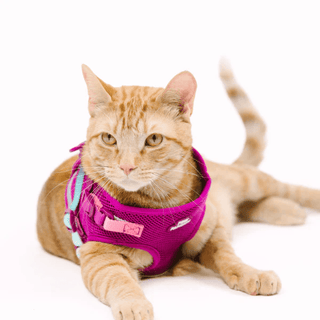
If you're also wondering what size harness for my cat, the measurement method is the same: neck at the base and chest just behind the front legs, matched to the brand's chart.
The two-finger rule applies equally.
What's different is the escape factor.
Cats are flexible enough to back out of a harness that would hold a dog just fine, so aim for a genuinely snug two-finger fit rather than anything looser, and plan for gradual indoor acclimation before outdoor use.
Our Stasia Cat Harness and Leash Set comes in small, medium, and large with four-way adjustable straps and low-light reflective details, making it easier to dial in a secure fit.
Fit Checks After Purchase
A harness that passed the two-finger test at home can behave differently once your dog is moving. These are the signs that something needs adjusting.
- The harness rotates or shifts to one side during a walk, usually meaning one side is tighter than the other or the chest strap is sitting too high or too low.
- Skin rolls or puckering appear around the neck or shoulders, a sign the harness is too tight in that zone even if it passed the finger test at rest.
- The dog shakes repeatedly or rubs against surfaces, pointing to chafing, most often behind the elbows or under the armpits.
- The dog backs up and the harness slides toward the head, meaning the girth strap is too loose or the harness design isn't escape-resistant enough for a dog that pulls backward.
- Front leg movement looks restricted or choppy at a trot, which can mean the harness is sitting over the shoulder joints rather than in front of or behind them.
The numbers on a dog harness sizing guide get you close, but a proper fit is confirmed by how the harness behaves on a real walk. For a detailed fit check, the AKC recommends fitting two fingers under the straps, ensuring the harness does not pinch while your dog stands or sits, and confirming that shoulder movement remains unrestricted Dog Harness Sizes: The Importance of a Well-Fitting Dog Harness. If something shifts or rubs, adjust before the next outing. Our harnesses are built with multiple adjustable buckles so you can fine-tune the neck, chest, and girth independently, making it much easier to resolve those in-between measurements without trading comfort for security. If you are wondering whether dogs can wear a harness all the time, regular fit checks and breaks can help protect your dog's comfort and skin.
Frequently asked questions
What size harness should I get if my dog is between sizes?
Choose the larger size when your dog’s measurements fall between two options, then adjust the straps for a snug fit. Check the neck and chest separately, since a larger chest size can still leave the neck opening too loose.
How often should I remeasure my dog for a harness?
Remeasure whenever your dog gains or loses noticeable weight, and check puppies every few weeks while they grow. A harness that fit recently may become tight around the chest or neck before it looks obviously small.
What harness works best for a dog that keeps slipping out?
Look for a highly adjustable design, and consider a three-point harness with neck, chest, and belly straps for escape-prone dogs. After fitting, walk your dog indoors and test whether you can gently back the harness over the shoulders without it coming free.
Can my dog wear the same harness for running and everyday walks?
Not always. For everyday walking, prioritize free shoulder movement and stable adjustment, while running calls for an even more secure fit with no rubbing under the arms, so one harness may not suit both activities.