



How to Tighten a Dog Collar, Step by Step
To tighten a dog collar, move the buckle to a tighter hole or pull the strap through the slider, depending on which kind you have. Either way, go a little at a time until two fingers slide flat underneath, with no room for a third (easier said than done with a wriggly furkid, we know). If two fingers won't fit, let it out a notch. If the collar still slips over those floppy ears when you ease it forward, take it in one more step.
The whole job takes about ten seconds, which is about as long as most doggos will sit still for a treat anyway. If the collar's too loose, your little escape artist can wriggle free the second a squirrel appears. If it's too tight, it rubs and pinches with every happy step.
How to Tighten a Dog Collar, Step by Step
- Get your dog settled, with a treat in your other hand if they're the wiggly type, and turn the collar so you can reach the buckle or clasp.
- Slide two fingers flat between the collar and your dog's neck to see where you're starting from.
- Shorten the strap. On a buckle collar, move the prong to a tighter hole. On a slide-adjust collar, pull the strap through the adjuster so the loop gets smaller.
- Fasten the collar again and repeat the two-finger check.
- Gently ease the collar forward toward your dog's ears. If it slides over them, go back to step three and take it in a little more.
- Tuck the loose strap end into the keeper loop, if your collar has one, so it doesn't flap around like a tiny flag.
That's the same two-finger rule the AKC's collar-fitting guide gives for everyday collars.
How to Tighten Each Collar Style
Buckle Collars
If you've ever wrestled with a belt after a big dinner, you already know how this works. Each hole is a fixed step, so move the prong one hole at a time and redo the two-finger check after each move. Stop at the first hole that passes the check and won't slip over your dog's ears.
Slide-Adjust and Quick-Release Collars
Slide-adjust collars are the easygoing ones. The strap glides through the adjuster instead of jumping between holes, so you can stop at exactly the right spot. Nudge it a little, recheck, and repeat until it's just right.
Martingale Collars
A martingale tightens when your dog pulls on the leash. Set it so it closes snugly enough that your little Houdini can't back out, but never so tight that it chokes. Check it both relaxed and with gentle tension on the leash, and follow the maker's fitting instructions, since designs vary.

When to Tighten Your Dog's Collar Again
Tightening a collar isn't a one-and-done job. Puppies seem to grow overnight, adult dogs gain or lose a little around the middle (no judgment, we've all had a cozy winter), and fluffy coats come and go with the seasons. The easy habit is a quick two-finger check every time you grab the leash, and our guide to how tight a dog collar should be has the other times to recheck. If you've ever wondered whether dogs like collars or just put up with them, we looked into that too.
When the Collar Won't Tighten Enough
Sometimes you hit the last hole or the end of the slider and the collar is still hanging loose (we've all ordered the size that looked right on the screen). That's your sign to go down a size, so measure your dog's neck where the collar sits and check it against the size chart. Our guide on how to measure a dog for a collar has the full method. Do not punch extra holes or knot the strap, because both weaken the collar, and a weakened collar can give way the moment your dog spots the neighbor's cat.
Little ones with tiny necks often do best in a narrower, lighter collar, so browse our small dog collars or our guide to the best dog collars for small dogs. For your gentle giants, our large dog collars and our guide to collars for big, strong dogs are great places to start.

When Tightening the Collar Isn't the Answer
If your dog has neck pain or tracheal disease (problems with the windpipe), no amount of tightening or loosening will fix it. A body harness puts far less pressure on that delicate area, and VCA's vets call it an excellent choice for these dogs. Take the harness off once you're home, though, and do not leave it on unless you're supervising your dog. Keep the collar on for ID, and have a chat with your vet about the setup that suits your best friend.

Picking a Dog Collar That's Easy to Tighten
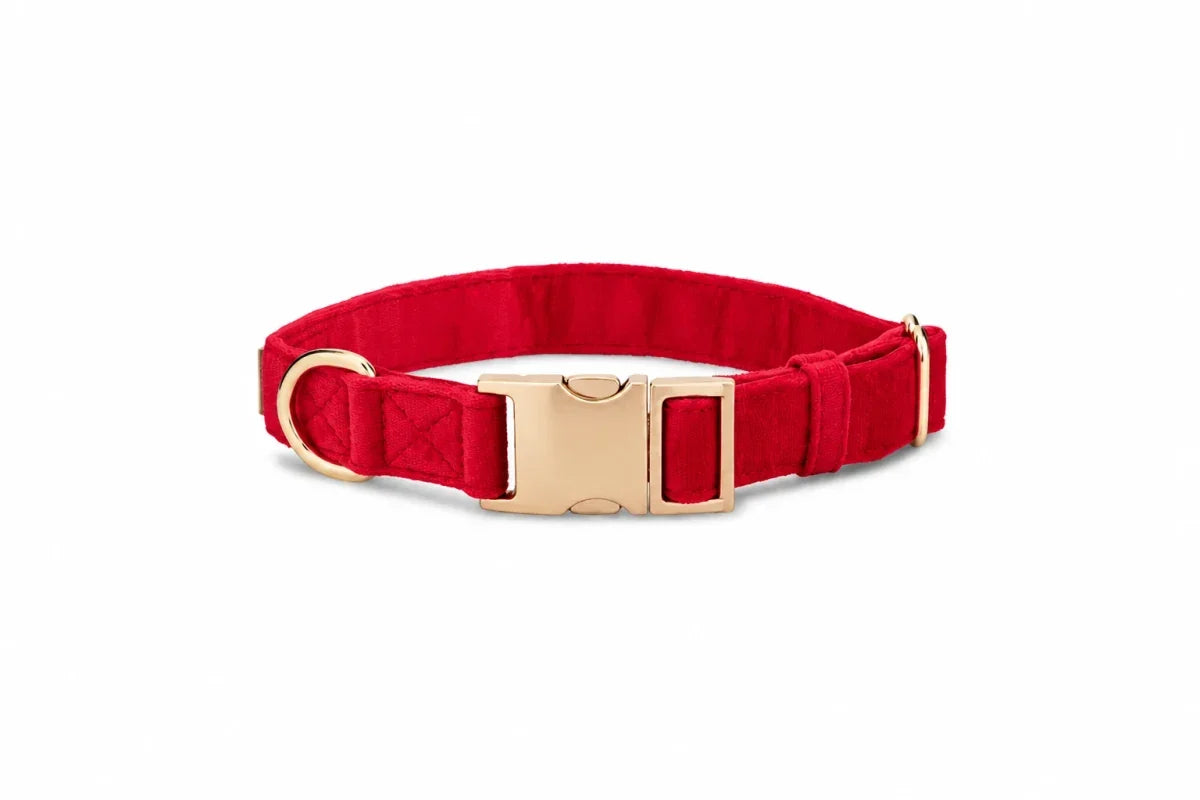
We want everyday gear to feel as good as it looks, through muddy walks, zoomies and the occasional roll in something smelly. Our dog collars come in soft velvet, waterproof and vegan leather styles, all with reinforced stitching and gold hardware. The waterproof and vegan leather styles buckle like a belt, and the rest adjust with a slider. If you're still choosing, our guide to good dog collars covers what to look for. Whatever you pick, your dog will be ready to strut.
Frequently asked questions
What if one hole is too loose and the next one is too tight?
Switch to a slide-adjust collar in your dog's size, since fixed holes can't split the difference. The strap glides through the slider, so you can stop right at a two-finger fit.
Why does my dog's collar keep getting loose?
Usually the strap has crept through a slide adjuster after enough tugging, zoomies and scratching. Retighten it, tuck the spare end into the keeper loop if there is one, and recheck weekly. If it slips again within a day or two, the adjuster's grip has likely worn out, and it's time for a new collar (your dog won't complain about a fresh look).