



Best Cat Harness for Walking: Secure Fit and Safety Tips
If you're getting ready to walk your cat, the best harness to put on them is a lightweight vest that you can adjust at both the neck and the chest. You'll clip the leash to a ring in the middle of their back, so whenever the leash goes tight, you're pulling against their chest instead of their throat. Once you've got the vest snug at the neck and chest, your cat can't easily wriggle out.
Maybe you're already picturing your cat slipping out halfway down the street. We get it. A cat's shoulders are looser than they look, so a startled cat can back right out of a harness that's even slightly too big, and it only takes seconds.
If you've ever watched your cat squeeze through a gap that you'd swear was too small for them, you know exactly what we mean. That's why you'll want to get the fit right before you ever open the front door, and it's why we keep the "arm" openings on our cat harness and leash sets on the small side.
Why Leash Walking Demands a Dedicated Harness
You might be wondering whether you can just clip the leash to your cat's collar. For walks, we'd always clip it to a harness instead of the collar. A cat can slip out of a collar with one good tug, and if they panic and pull, they can hurt their neck.
Skip long and retractable leashes, too. With one of those, you're giving your cat enough slack to bolt up a tree or over a fence before you can react, so stick to a short, fixed-length leash.
If you've walked a dog before, you've probably felt a scared dog pull forward on the leash. A scared cat usually twists and backs up. So when you're choosing between the different types of cat harnesses, pick one that stays snug when your cat pulls backward but still feels light enough that they forget they're wearing it.
Essential Qualities of a Reliable Walking Harness
When you're comparing harnesses, check that the neck and the chest adjust separately. That way, you can snug up the neck without squeezing your cat's chest, and when they drop their head to pull out, the neck opening stays tight around them.
That's why we put four adjustment points on our cat sets. If escaping is your biggest worry, you'll find more fit checks in our guide to escape-proof cat harnesses.
Then look at where the leash clips on. You want a metal ring on the back of the harness, which is the spot vets recommend. With the leash clipped there, it hangs above your cat's shoulders instead of tangling around them.
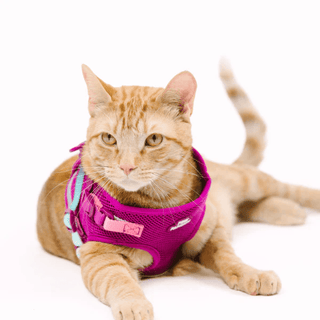
If you'd rather not play matchmaker with a harness and a separate leash, we've done it for you. In each of our cat harness and leash sets, you get a breathable mesh vest and a leash that matches it. The vest has a reflective strip and a small AirTag pocket, so if your cat ever does slip away, you've got a way to track them down. All you have to pick is the color.

How to Fit and Introduce a Cat Walking Harness
We know it's tempting to put the harness on and head straight out the door. A cat who's rushed into a harness often panics, though, so plan on working through these steps indoors over a few days, or a few weeks if your cat's nervous.
- Measure your cat first. Wrap a soft tape measure around their chest just behind the front legs. Then measure their neck where a collar would sit, and pick the size that fits both numbers. You'll find the full walkthrough in our guide on measuring a cat for a harness.
- Let them get to know the harness. Lay it over their back, give them a treat, and take it off again. Once they're relaxed about that, buckle it on and adjust the straps until you can slide two fingers underneath. Keep these sessions short, and always take the harness off while your cat is still calm. If you're starting with a grown-up cat, you'll find a full plan in our guide to harness training an adult cat.
- Add the leash indoors. Clip on a short, lightweight leash and let your cat drag it around the house while you keep an eye on them. When they're ignoring it, pick up the end and follow them from room to room. Your cat sets the pace here, so keep the leash loose and never tug them toward where you want to go.
- Test the fit before you go outside. Gently pull the leash back toward their tail and check that the neck opening doesn't slide forward over their ears.

Outdoor Safety Checks and Behavioral Readiness
Once your cat's happy walking around the house on a leash, you're almost ready to head outside. Before that first trip, book a quick checkup with your vet. They'll make sure that your cat's up to date on vaccines and flea, tick and heartworm prevention, and the checkup's a good time to ask about a microchip if your cat doesn't have one yet.
Then get into the habit of checking the harness before every walk. Look over the stitching and buckles, and give the leash ring a tug. Your cat's claws and teeth can wear through straps over time, so if you spot fraying anywhere, it's time for a new harness.
For your first few walks, pick a calm, enclosed spot like your own backyard, away from busy roads and loose dogs.
Keep an eye on your cat the whole time. If they flatten themselves to the ground, freeze, or start panting, they're telling you that they're scared. Scoop them up calmly and head back inside. It's completely fine if your first walk only lasts a couple of minutes, and you can try again another day.

When you've found a harness you like, give it one last check before that first walk: slide a finger under the straps behind your cat's front legs. That's where a harness is most likely to pinch, so if it feels tight there, loosen it a little. And if you're stuck between two sizes, message us before you order, and we'll help you pick.
Frequently asked questions
Can Every Cat Learn to Walk on a Harness?
No, not every cat will take to it, and that's okay. Some cats just hate feeling held, and if yours keeps freezing or flattening themselves to the ground outside, that's your sign to stop the walks. You can still give them fresh air and new smells with an enclosed outdoor space (a catio).
What If the Harness Rotates When My Cat Walks?
Take it off and tighten the straps a little, then try again. If it still twists when your cat walks or backs up, it's probably the wrong size or style for them, so try a different one before you head outside.
How Should I Fit a Harness on a Long-Haired Cat?
When you slide two fingers under the straps to check the fit, press down through the fur so that you can feel how snug they are, because long fur can make a loose harness look like it fits. Look for smooth, soft straps, too, since rough edges can tangle long fur.
Does My Cat Need a Matching Leash?
No, any short, lightweight leash will work, as long as its clip fits the ring on the harness and closes securely. It's nice not to have to go looking for one, though. Every one of our cat harness and leash sets comes with a leash that matches the harness, so you're not left wondering what goes with what.