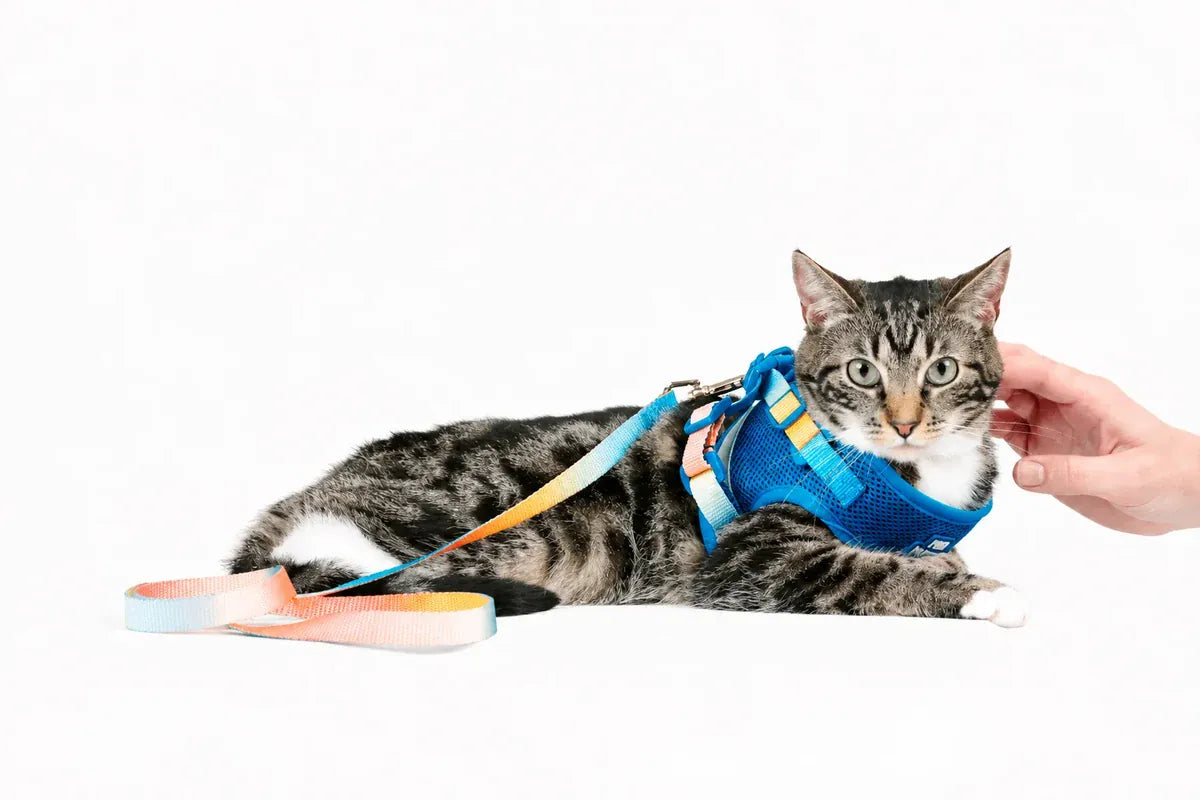




Best Harness for Cats Escape Proof: A Secure Fit Guide
If your cat has wriggled out of a harness before, look for a vest that covers their chest and ribs and adjusts at the neck and behind the front legs separately. The fit is more important than the tightness, because when a vest is snug in both places, your cat has nothing to back out of.
No cat harness is completely escape-proof, whatever the box says. A frightened cat can flatten their shoulders and reverse out of almost anything, so what you're really doing is making that as hard as possible. It's why we cut the arm openings small on our cat harness and leash sets, and why they adjust in four places rather than two.
What Makes a Cat Harness Truly Escape Resistant?
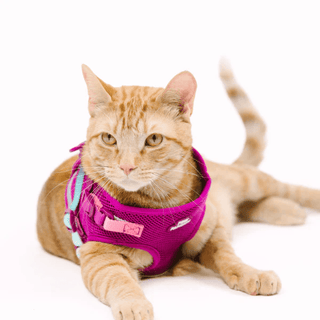
Two things keep a cat in a harness. The first is coverage, so look for a vest that sits across their chest and continues behind their front legs, rather than a couple of thin straps. The second is separate adjustment at the neck and the body, because a reversing cat pushes the whole harness forward along themselves, so the body strap rides up over their shoulders while the neck opening slips over their head. You want to be able to tighten that neck opening without squeezing their ribs.
Check the arm openings too. A wide opening leaves room for a leg to come through sideways, which is how a lot of escapes start, and it's why ours are cut small.
Then look at what it's made from. A soft, flexible fabric follows the shape of your cat, so there's no gap when they crouch down or turn to look behind them. Stiff webbing does the opposite, rubbing under their front legs and leaving space that opens up the moment they move. If you want to compare the shapes side by side, our guide to the types of cat harnesses goes through them.

How to Fit a Cat Harness for Maximum Security
Get the fit right indoors before you go anywhere.
- Measure your cat's chest. Wrap a soft tape around the widest part, just behind their front legs, while they're standing. Our cat sets come in small, medium and large, so check that number against the size chart rather than guessing from their weight. There's a full walkthrough in our guide on measuring a cat for a harness.
- Put it on in a quiet room. Fasten the neck first, then the strap that goes behind their front legs. Our guide on putting on a cat harness has the order and the timing if your cat objects to the whole idea.
- Do the two-finger check on every strap. You want two flat fingers underneath, no more. Then watch what happens when your cat crouches or turns around, because that's when a gap opens up, and if it does, take up the slack evenly on both sides.
- Test it in both directions. Keep light tension on the leash in front of your cat and encourage them to take a step back, the way they would if something startled them. The harness shouldn't creep forward along them or ride up toward their ears. Then hold the leash still and let your cat walk forward into it, and watch whether they can duck a shoulder and work a front leg out through an arm opening. If either happens, tighten the neck first, then the body strap, and try again.

Can You Use a Dog Harness on a Cat?
No, not even a small one. A dog harness is built for a chest that fills it out, and a cat leaves gaps under the front legs where a dog's shoulders would sit. Those gaps are exactly where a cat gets a leg out.
The hardware is the other half of it. Buckles and rings sized for a dog are heavy on a cat, and a cat carrying too much weight on their back tends to flatten out and stop walking altogether.
So go for something built for a cat. Our cat harness and leash sets use narrow straps, small arm openings and light hardware, and each one comes with a matching leash that's the right weight to go with it.
Indoor Conditioning and Leash Protocol
Start indoors. A cat who meets a harness for the first time in the front yard usually panics, and a panicking cat is exactly the cat who gets out of one.
Let yours wear it around the house first, a few minutes at a time, with treats. Once they'll walk around in it without crouching or freezing, clip on the leash and follow them from room to room. If you're doing this with a grown cat rather than a kitten, our guide to harness training an adult cat takes it more slowly.
When you do go out, use the harness rather than a collar. VCA says a cat can slip a collar too easily, and a collar puts everything onto their throat if they bolt. Use a light leash of about four to six feet, and skip the retractable kind, which gives a startled cat enough slack to get up a tree before you can do anything about it.
Keep the first trips short and stay in a quiet yard. Let your cat choose where to go and how fast, and if a loose dog turns up, pick your cat up and head inside.

Recognizing Stress and Handling Travel
Watch your cat while you're out. A cat who's had enough crouches low with their feet tucked under them, freezes, or starts panting, so take the harness off and head back inside. A frightened cat who does get loose can run into a road or disappear over a fence, and that's the situation all of this is meant to avoid.
Check their chest and under their front legs after each walk. Rubbed fur, damp patches or pink skin along a strap line all mean the harness is sitting wrong, so loosen that strap or move it before the next trip.
One thing a harness doesn't replace is a carrier. Even a cat who walks happily on a leash goes to the vet in a carrier, because a waiting room full of dogs is a different proposition from a quiet yard.
Check the fit again every few months, and after a winter coat comes in or your cat gains or loses weight. A harness that fitted in October can be loose by April. It takes two minutes with two fingers, and it's the difference between a cat who's wearing a harness and a cat who's about to be out of one.
Frequently asked questions
When Should I Size Down Instead of Tightening?
When you've run out of easy fixes. If the harness spins round on your cat, gapes at the shoulders, or lets a front leg slip out, the shape or the size is wrong, and pulling the straps past the two-finger fit only makes your cat miserable without fixing it.
My Cat Freezes When I Put It On. Is That Fine?
No, that's your cat telling you they're not comfortable. Take it off and check the fit, because a strap sitting in an armpit or across the shoulders will stop a cat moving. Then go back to short indoor sessions with treats. Some cats need a few weeks of that, and a few never take to it at all.
What Do I Do If My Cat Gets Out of the Harness?
Don't chase them. Crouch down, stay still and call them the way you would at home, because a cat who's bolted will usually stop and hide close by rather than keep running. Once you've got them, go straight indoors and work out which strap let go before you go out again.
Can My Cat Wear the Harness Around the House?
We'd take it off once the walk is done. If you want to leave it on for a while indoors, keep it to short stretches while you're in the room, because a strap can hook on a door handle or a chair, and a cat who panics while they're caught can hurt themselves.