




Types of Cat Harnesses: Compare Styles and Fit
Cat harnesses come in three shapes: mesh vests, H-style strap harnesses and full jackets. A vest covers your cat's chest and ribs, an H-style is mostly straps and air, and a jacket goes further back along their body.
Most cats do best in a vest, and that's what we make, because the wider the coverage, the less there is to wriggle out of. The straps suit a cat who hates the feel of fabric on them, particularly in summer. Whichever you pick, don't walk your cat on a collar. Cats reverse out of them, and the leash pulls on the one part of a cat you least want it pulling on.
The Primary Types of Cat Harnesses
H-style straps. Two loops joined by a strap along the back, one round the neck and one round the belly. There's almost nothing to it, which is the appeal in hot weather and for cats who object to being covered up. It's also the easiest of the three to get out of, since a cat who backs up has two loops to work with rather than a panel.
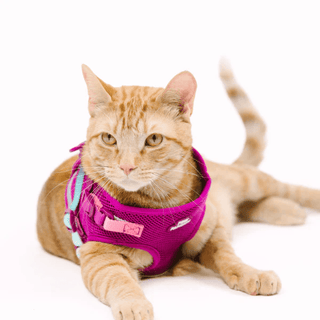
Mesh vests. A wide panel across the chest and ribs, closing with velcro and buckles at the side. There's more material against your cat, which some cats take a week or two to accept, and in exchange a pull spreads across their chest instead of pulling on two straps. Our cat harness and leash sets are this shape.
Jackets. Like a vest, but it continues further back toward the hips. They suit cats who've escaped from everything else, and they're the warmest of the three, so they're a poor choice in summer or for a long-haired cat who overheats.
The shape you choose matters less than whether you can adjust it in two places, at the neck and behind the front legs. That's what lets you set the neck snug enough to stop your cat reversing out without squashing their ribs, and it's the thing to check before anything else.

Matching the Harness to Your Cat's Needs
Work from what your cat already does.
A cat who's got out before. Go for a vest or a jacket, and check the neck adjustment before you buy. Our guide to escape-proof cat harnesses has the checks that catch a harness your cat can reverse out of.
A cat who flattens or freezes when you put anything on them. Start with the straps, since there's less of it against them, and expect to spend a few weeks on it rather than an afternoon.
A cat who pulls toward things. Any of the three works, as long as the fit is right. What stops a pull hurting your cat is spreading it over their chest rather than their throat, which all three do, and a snug fit so nothing shifts when they lunge.
A long-haired cat. Straps or a vest, and check under the front legs after each walk, since that's where fur mats first.
Whichever way you go, measure your cat before you buy rather than after. Our guide on measuring a cat for a harness has the two numbers you need.

How to Introduce and Fit a New Harness
Whichever shape you've bought, the introduction is the same, and it's slower than most people expect.
- Leave it out where your cat sleeps for a few days, with a treat beside it.
- Put it on loosely for a minute, give them a treat, and take it off while they're still relaxed. Two flat fingers under every strap, no tighter.
- Clip the leash on indoors once they're walking around normally in it, and follow them rather than steering.
- Go outside only when all of that is boring. Somewhere quiet and enclosed, ten minutes at most.
Our guide on putting on a cat harness has the order for a vest, and our guide to harness training an adult cat goes at the pace an older cat needs.

Hardware, Upkeep, and Outdoor Habits
Look at the clip before you buy. A snap hook sized for a dog is heavy enough to drag a cat's harness off center, and the leash that comes with our cat harness and leash sets is matched to the harness for that reason. Clip it to the ring on your cat's back, never to their collar, which is too easy for a cat to slip.
Take the harness off when you come in. A strap can hook on a chair leg or a door handle while you're in another room, and some cats will chew a buckle they're left alone with.
Wash it by hand in warm water with a mild soap, then towel it dry or leave it to air dry. Grit dried into mesh rubs the skin under your cat's front legs.
One last thing, and it matters more than which shape you pick. Not every cat wants to go outside. A harness takes away their ability to run home, which is the whole basis of how a cat feels safe outdoors, so a cat who's still frightened after weeks of slow introductions isn't going to come round with more practice. Stop there. Window perches, a catio and a bird feeder on the sill give that cat the outside world without the part they can't cope with.
Frequently asked questions
What About Figure-Eight Harnesses?
They're the fourth shape you'll see, made of two loops that tighten when your cat pulls. That tightening is the problem, because the pressure ends up round your cat's neck, so we'd pick one of the other three. If you're already using one, check that it isn't pulling tight anywhere when your cat leans into the leash.
Which Shape Is Easiest to Put On?
The vest, once your cat accepts it, because the panels close along their side and nothing goes over their head. H-style straps are quicker to fasten but fiddlier to get straight, and it's easy to end up with the belly loop round the wrong part of your cat.
Can I Use the Same Harness for Two Cats?
Only if they measure the same and they're happy to share. Most cats aren't, and a harness that smells of another cat can be the reason one of them refuses to wear it. If you've got two cats, two harnesses saves you a lot of guesswork about which one the fit was set for.
Does My Cat Need a Collar as Well?
Yes, for ID tags. Walk them on the harness and leave the collar on for identification, with a breakaway clasp so it comes undone if your cat catches it on something.