





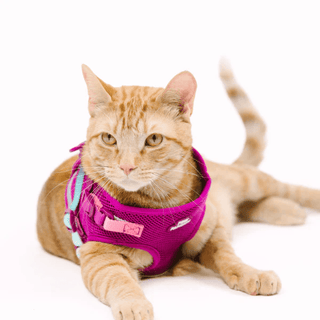
How Do You Put on a Cat Harness? Step-by-Step Guide
If you've ever tried this out of the blue, you already know how it goes. Harness comes out, cat disappears under the bed or up the curtain, and you're left holding a mesh vest and a handful of treats. Do it slowly instead and most cats come round.
Putting a harness on a cat comes down to three moves. Close the neck panel, close the body panel behind their front legs, then even out the straps until you can slide two flat fingers under the mesh.
Most of the work happens before that, though. A cat who's never seen a harness will object to being wrapped in one, so leave it out by their bowl for a few days and let them decide that it's part of the furniture. When you do put it on, sit on the floor with treats in one hand rather than holding your cat still on a counter, and keep the first few goes to a minute or two.
Preparing Your Cat for the Harness
Before you even start looking at harnesses, measure your cat. An adventure in itself, as you'll discover, but you need two numbers before you can size anything: their chest, taken just behind the front legs, and their neck. If your cat isn't cooperating, our guide on measuring a cat for a harness has a few tricks that help. Get those numbers right, because a harness that's a size out is the one that your cat will get out of.
It also helps to know which kind you've got before you start, since a vest goes on differently from a strap harness. Our guide to the types of cat harnesses shows what each one looks like.
Then put the leash away for now. You're only getting your cat used to wearing something, and a leash trailing behind them on day one gives them one more thing to panic about. Walk them on the harness rather than a collar when you do go out, since a cat can slip a collar too easily if something startles them.
How to Put on a Cat Harness Step-by-Step
Pick a moment when your cat looks cooperative, or at least unlikely to turn into a spiky whirlwind, and work through it in this order.
- Sit on the floor with your cat, the harness and a few treats beside you. Let them come to you rather than lifting them onto a counter.
- Open both velcro panels and unclip the buckles, then work out which way round it goes. The leash ring sits on your cat's back, between the shoulder blades, and the narrower panel is the one that goes round their neck.
- Lay the harness over your cat's back, with the neck panel up by their shoulders and the mesh sitting flat along their side.
- Close the neck first. Bring the panel round under their throat, press the velcro down, and check that you can slide two flat fingers between the mesh and their neck.
- Close the body panel the same way, behind their front legs, then clip both buckles. Keep a finger between the buckle and their fur so you don't catch any skin.
- Even out the four sliders until the mesh lies flat on both sides, then run the two-finger check again. Give your cat a treat, leave it on for a minute or two, and take it off while they're still relaxed.

Checking Proper Fit and Security
With the harness on, run the two-finger check again on every strap, since cats settle differently once they've moved around. A harness needs to sit snugly around the chest and belly without pinching anywhere.
Then look down at your cat from above. The leash ring should sit in the middle of their back, between the shoulder blades. If the whole harness has slid round to one side, the straps aren't even, so loosen both sides and redo them together rather than yanking one tighter.
Now test it in both directions, because a cat gets out of a harness two ways. Hold the leash in front of them with light tension on it and encourage them to step back. The harness shouldn't creep forward along your cat or ride up toward their ears. Then let your cat walk forward into the leash and watch whether they can duck a shoulder and push a front leg out through an arm opening. If either happens, tighten the neck first, then the body strap, and try again.

Reading Stress Signals and Building Routine
Plenty of cats flop onto their side the first time a harness goes on, or freeze where they stand. That isn't your cat being stubborn. They're waiting to see what happens next, and the fix is to make something good happen. Put a treat down in front of them, or trail a feather wand a foot or two away, and let them walk to it in their own time.
Stop the session if your cat's tail starts swishing, their ears go flat, or they scramble backward out of your hands. Take the harness off without a fuss and try again the next day, since pushing through that turns the harness into the thing that ruins their afternoon.
Build the time up slowly from there. Two or three minutes indoors is plenty at the start, and most cats need a couple of weeks of that before a leash comes into it. Our guide to harness training an adult cat sets out the pace if your cat is past kittenhood, where this usually takes longer.
One more thing to say here, since it's our own kit we're talking about. Every Pink Papyrus harness is reviewed by our in-house vet, Dr. Kirollos, before it goes on sale, and fit and comfort are what he's checking for.
Selecting the Right Walking Gear
When you go shopping, buy one made for a cat rather than the smallest dog harness on the shelf. Our cat harness and leash sets are lightweight mesh with a reflective strip and a leash that matches, and they come in small, medium and large.
We wouldn't put a dog harness on a cat at all. Cats are built differently and they move differently, so a harness cut for a dog leaves gaps under the front legs where a dog's shoulders would fill it out, and the heavier buckles sit on a cat in a way that can rub or catch. That combination is uncomfortable at best, and at worst your cat gets hurt or gets loose. If yours has already escaped from one, our guide to escape-proof cat harnesses has the checks.

Transitioning Safely Outdoors
Once your cat walks around the house happily in the harness, clip the leash on indoors and follow them from room to room. Keep it loose, let them decide where to go, and don't try to steer.
For the first trip outside, carry your cat out in their carrier rather than walking them out of the front door. Put the harness on before they go in, clip the leash to it, and keep hold of the leash while you carry the carrier. Set it down somewhere quiet, then open the door with the leash already in your hand and let them come out when they're ready, which might be straight away or might be ten minutes. If they'd rather stay in the carrier, take them back inside and try again another day.
Give the buckles and the leash clip a quick look each time before you go. Then keep the first few trips short, because five minutes in the yard is a better start than half an hour that ends with a frightened cat. Our guide to walking a cat picks up from there.
Frequently asked questions
How Do I Tell Which Way Round the Harness Goes?
Find the leash ring first. It sits on your cat's back, between the shoulder blades, and the wider panel goes across their chest. If the ring ends up under your cat or off to one side, the harness has gone on twisted, so take it off and start again rather than trying to turn it on them.
My Cat Goes Limp and Won't Walk. What Now?
That's normal, and most cats come out of it in a few sessions. Leave the harness on for a minute or two, put a treat a step away, and let them come to it. If your cat is still flopping after a couple of weeks, check the fit across their shoulders, since a harness that's too tight there stops a cat moving.
Can I Leave the Harness On While My Cat Gets Used to It?
Only while you're in the room. Take it off once the session ends, because a strap can hook on a door handle or a chair leg, and a cat who panics while they're caught can hurt themselves.
What If My Cat Gets the Harness Off Indoors?
Watch how they did it, because that tells you which strap to fix. A cat who reverses out of the neck opening needs the neck tightened first. A cat who works a leg out through an arm opening needs the body strap taken in. If neither adjusts far enough, the size or the shape is wrong for your cat.